Garden Design
6 Low Maintenance Ornamental Grasses for a Cottage Garden
6 Low Maintenance Ornamental Grasses for a Cottage Garden
5
min read

🌾 6 grasses, 2–5 ft tall | ☀️ Full sun | 🌱 Low maintenance | ✂️ Cut back late winter/early spring
I don't know about you, but for the longest time, I felt completely confused by ornamental grasses. When you walk through a plant nursery, it is almost impossible to imagine what they will look like in your garden beds a year, two, or three down the road.
However, after adding them into my own cottage garden, I can tell you without hesitation: do not skip these wonderful plants.
They are absolute must-haves!
In a cottage garden, ornamental grasses bring texture, structure, and dynamic motion. And they make your garden lush, even when your flowers are done blooming.
Best Low Maintenance Ornamental Grasses
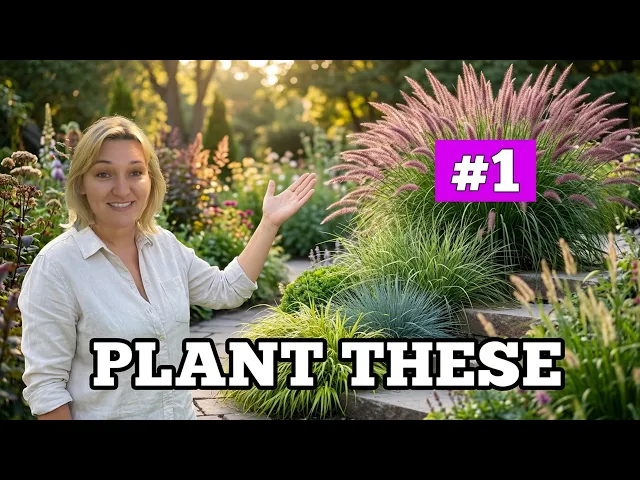
To help you navigate the overwhelming options at the garden center, I am sharing six of my favorite ornamental grasses. For me they are must-have plants for a low maintenance garden design. I’ve ranked them starting from my least favorite up to my absolute #1 top performer, showing you exactly how they behave in a real cottage garden landscape!
The varieties I share here fall right into the sweet spot of 2-5 feet tall, because they never overpower the surrounding plants.
You can also watch my video here:

Shop My Favorite
Ornamental Grasses
6. 'Cheyenne Sky' Switch Grass
(Panicum virgatum 'Cheyenne Sky')
Get 'Cheyenne Sky' Switch Grass 10% off here.
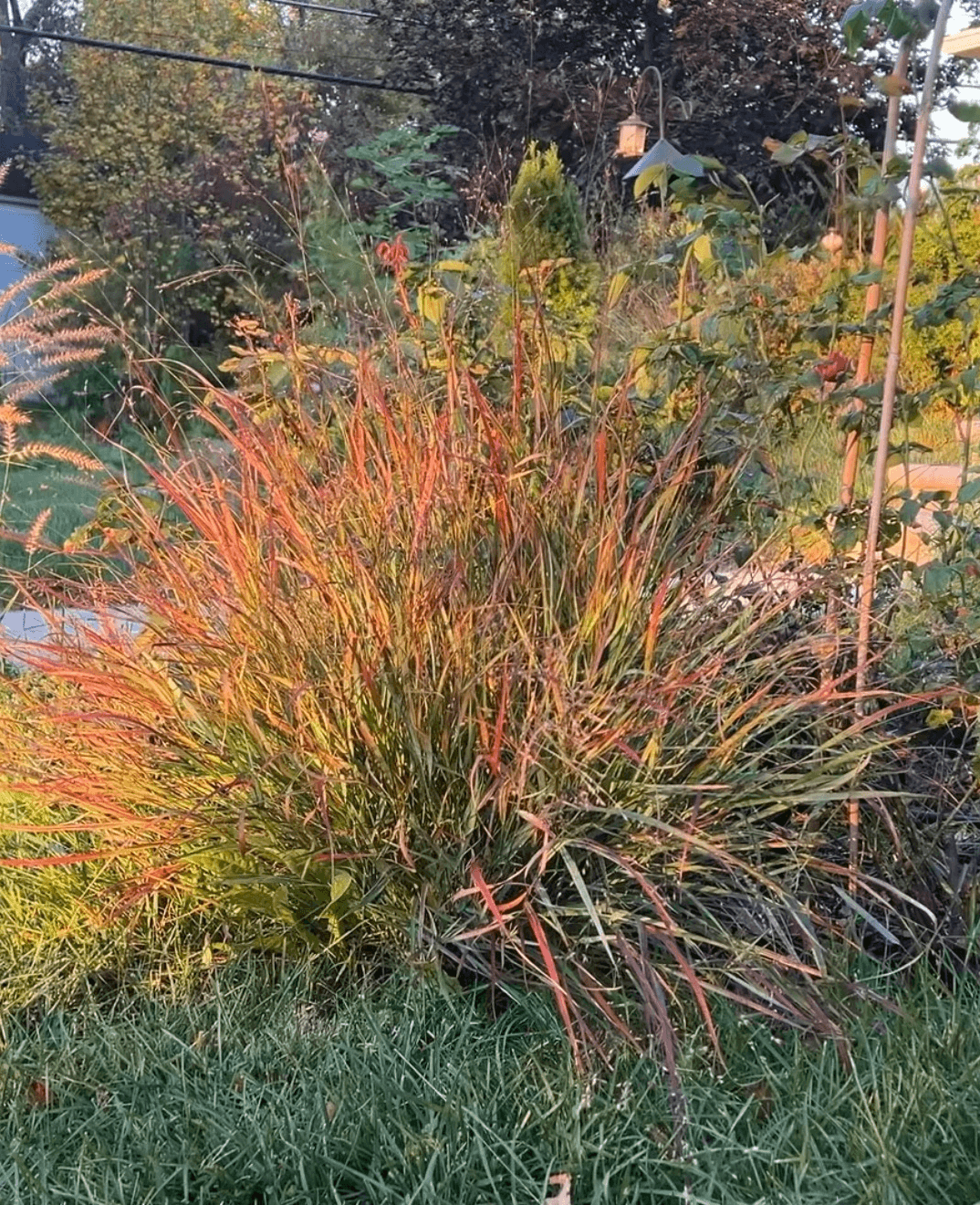
At number six on my list is 'Cheyenne Sky' Switch Grass. I have a soft spot for this plant because of its incredible resilience. Last fall, I bought a pitiful, completely dry-looking clump on clearance. By this fall, it had recovered so beautifully! It serves as a fantastic reminder to all gardeners: don't be afraid of those sad, end-of-season clearance grasses. Given a little time and soil, they can look spectacular the following year.
What I love about 'Cheyenne Sky' is its multidimensional color palette.
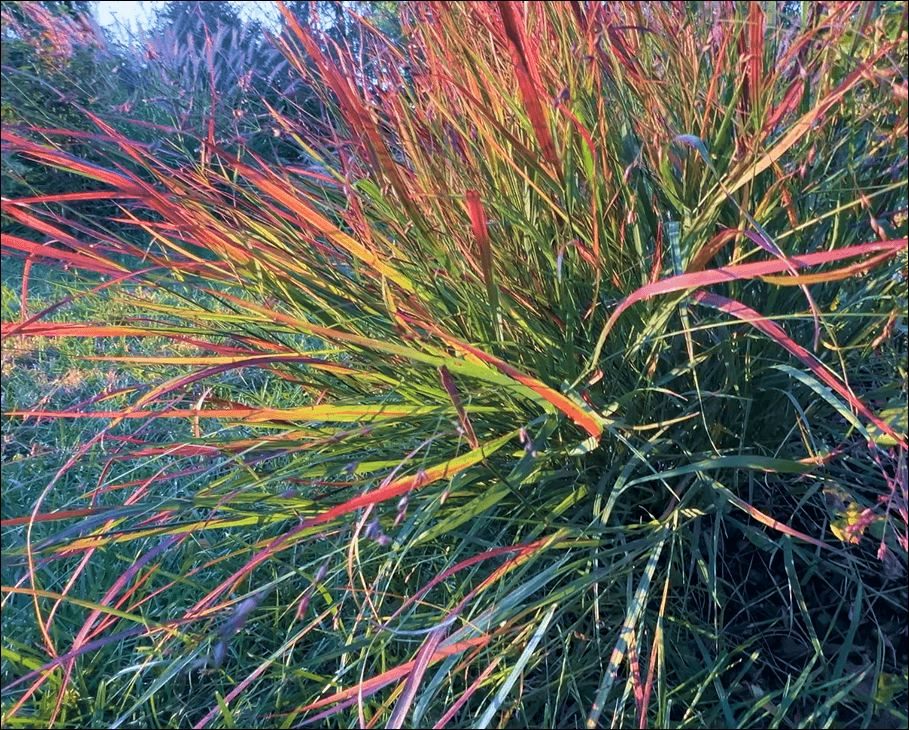
The foliage has soft, bluish-green tones early in the season that deepen into rich shades of deep purple and rosy pink as the summer turns to autumn. It is a subtle, stunning plant. The only reason it sits at number six on my personal ranking is that it is the least striking grass in my beds right now. You really have to walk up to fully appreciate its colors. It functions wonderfully as a quiet bed filler, weaving together brighter flowers, but it isn't going to be the dramatic showstopper of your garden border.
Growing Needs for 'Cheyenne Sky' Switch Grass:
This tough native cultivar typically reaches a mature height of 2 to 3 feet tall (up to 3 feet when in bloom) with a narrow spread of 1.5 to 2 feet. It thrives best in full sun (at least 6 hours of direct light daily) to maintain its strong, upright habit and vivid purple foliage. Hardy in USDA Zones 4 through 9, 'Cheyenne Sky' is exceptionally adaptable to a wide range of soil types, including heavy clay and dry sandy soils. It requires low to medium moisture and becomes quite drought-tolerant once established.
5. Pink Muhly Grass
(Muhlenbergia capillaris)
Get Pink Muhly Grass 10% off here.
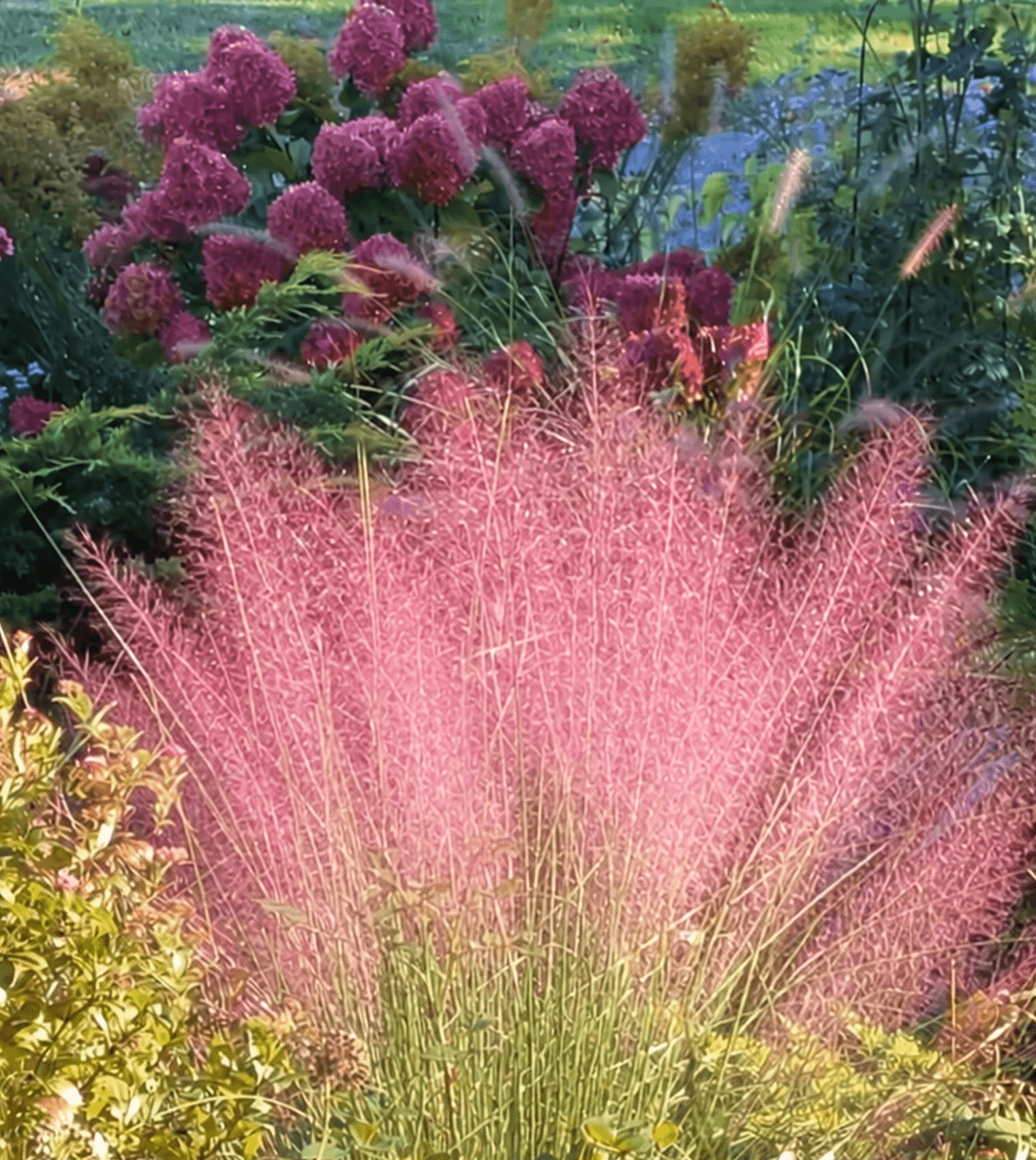
Oh, Pink Muhly Grass! This plant could easily take the number one spot in my heart if it weren't for a few frustrating flaws. When Pink Muhly Grass is in its full autumn glory, it transforms the garden into a romantic, soft, cotton-candy pink cloud. It adds a magical, dreamy haze over the garden beds that takes your breath away.
So why is it down at number five? Simply put, it has a tendency to flop. I have been waiting patiently for my Pink Muhly Grass to look picture-perfect for about four years now, but it has never quite filled out or stood as sturdy as some of my other ornamental grasses. Part of this might be my own fault—I planted it in rich soil. I am currently looking into transplanting it to a new location with leaner soil to see if that tightens up its form. Additionally, it is a late bloomer. The pink plumes usually don't open until October, whereas many of my fountain grasses are already putting on a grand show by mid-summer.
Growing Needs for Pink Muhly Grass:
Pink Muhly Grass reaches a mature height of 2 to 3 feet with a matching spread of 2 to 3 feet. It performs best in full sun and requires very well-draining soil. Hardy in USDA Zones 6 through 10, this grass naturally thrives in poor, lean, or sandy soils; overly rich soil or excess water can actually cause the weak stems to flop over. It is extremely drought-tolerant once established and prefers deep, infrequent waterings.
4. 'White Cloud' Muhly Grass
(Muhlenbergia capillaris 'White Cloud')
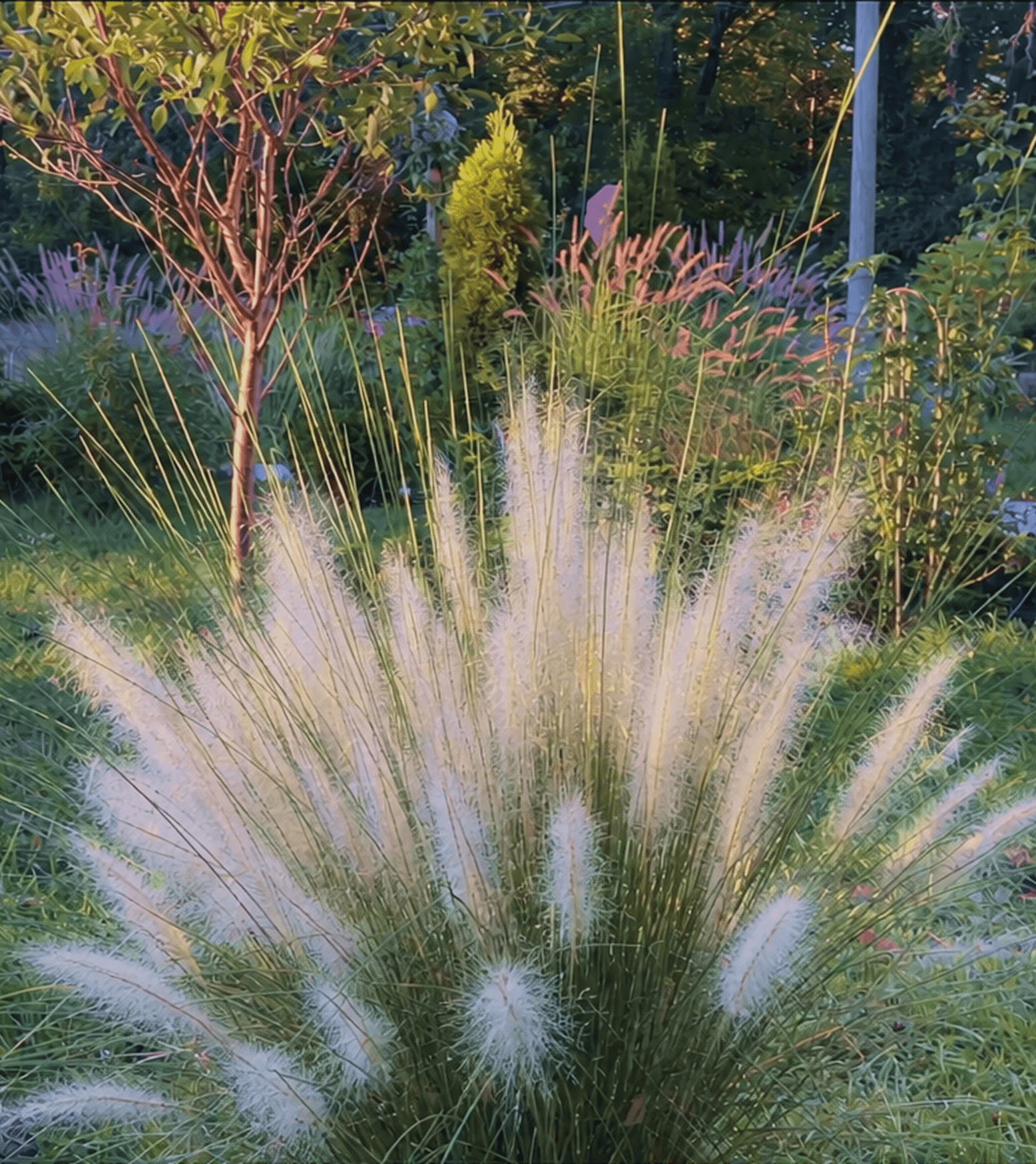
If you love the airy, ethereal look of Pink Muhly Grass but want to avoid the flopping issues, 'White Cloud' Muhly Grass is an outstanding alternative. Occupying the fourth spot on my list, this variety has elegant, fine-textured ivory-white haze that looks like delicate mist hovering over your garden beds.
'White Cloud' grows slightly taller and significantly more upright than its pink sibling. It was specifically selected for its architectural strength, meaning you won't spend the season watching your beautiful foliage collapse onto surrounding perennials. Like Pink Muhly, it begins its bloom cycle in October. The fluffy white seed heads start developing right in the center of the plant foliage first, gradually expanding outward until the entire top of the plant is smothered in a soft white veil.
Growing Needs for 'White Cloud' Muhly Grass:
This cultivar achieves a mature height of 3 to 4 feet tall and a spread of 2 to 3 feet wide. It requires a location in full sun to keep its flower stems rigid and upright. Hardy in USDA Zones 6 through 10, 'White Cloud' tolerates heat, humidity, and drought with ease. Plant it in well-draining soil of average to low fertility, and avoid overwatering or heavy fertilizing to preserve its refined upright form.

Real plants. Real garden.
Honest perspective.
I share what works in my garden, including the mistakes!
3. 'Hameln' Dwarf Fountain Grass
(Pennisetum alopecuroides 'Hameln')
Get 'Hameln' Dwarf Fountain Grass 10% off here.
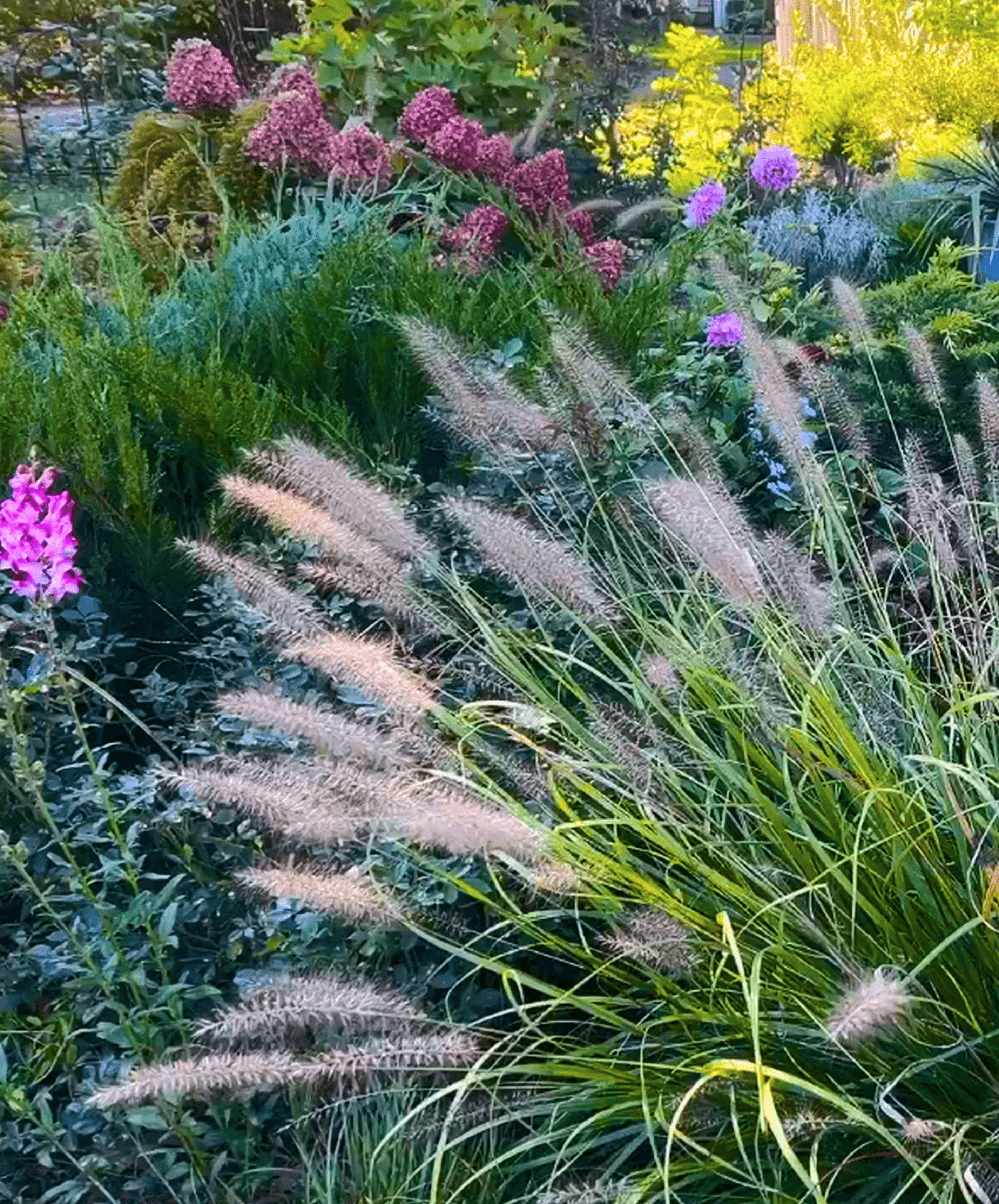
Coming in at number three is a absolute classic: 'Hameln' Dwarf Fountain Grass. This is probably the most standard fountain grass you will find at almost any garden center or nursery, and for good reason! It is an incredibly reliable, low-fuss workhorse in the cottage border.
I love 'Hameln' because of its neat, rounded, mound-forming habit. When you first plant it, it stays around 3 feet tall and 3 feet wide. However, as the years go on, the base slowly expands. The plant in my garden has been in my garden for three years now; it started out small, but today it stretches out to 4+ feet wide! Its rich green foliage arches gracefully outward, topped with creamy, beige-colored "foxtail" plumes that dance in the wind. It's also beautiful in early spring with its lime green blades.
Growing Needs for 'Hameln' Dwarf Fountain Grass:
'Hameln' typically matures to 2 to 3 feet tall and spreads 3 to 4 feet wide over time. It thrives in full sun to light shade, though full sun produces the most abundant blooms. It is hardy in USDA Zones 5 through 9. This grass prefers fertile, medium-moisture, well-draining soils, though it can tolerate periodic dry spells once its roots are settled. Yearly spring cut-backs keep the foliage looking crisp and vigorous.
2. 'Red Head' Fountain Grass
(Pennisetum alopecuroides 'Red Head')
Get 'Red Head' Fountain Grass 10% off here.
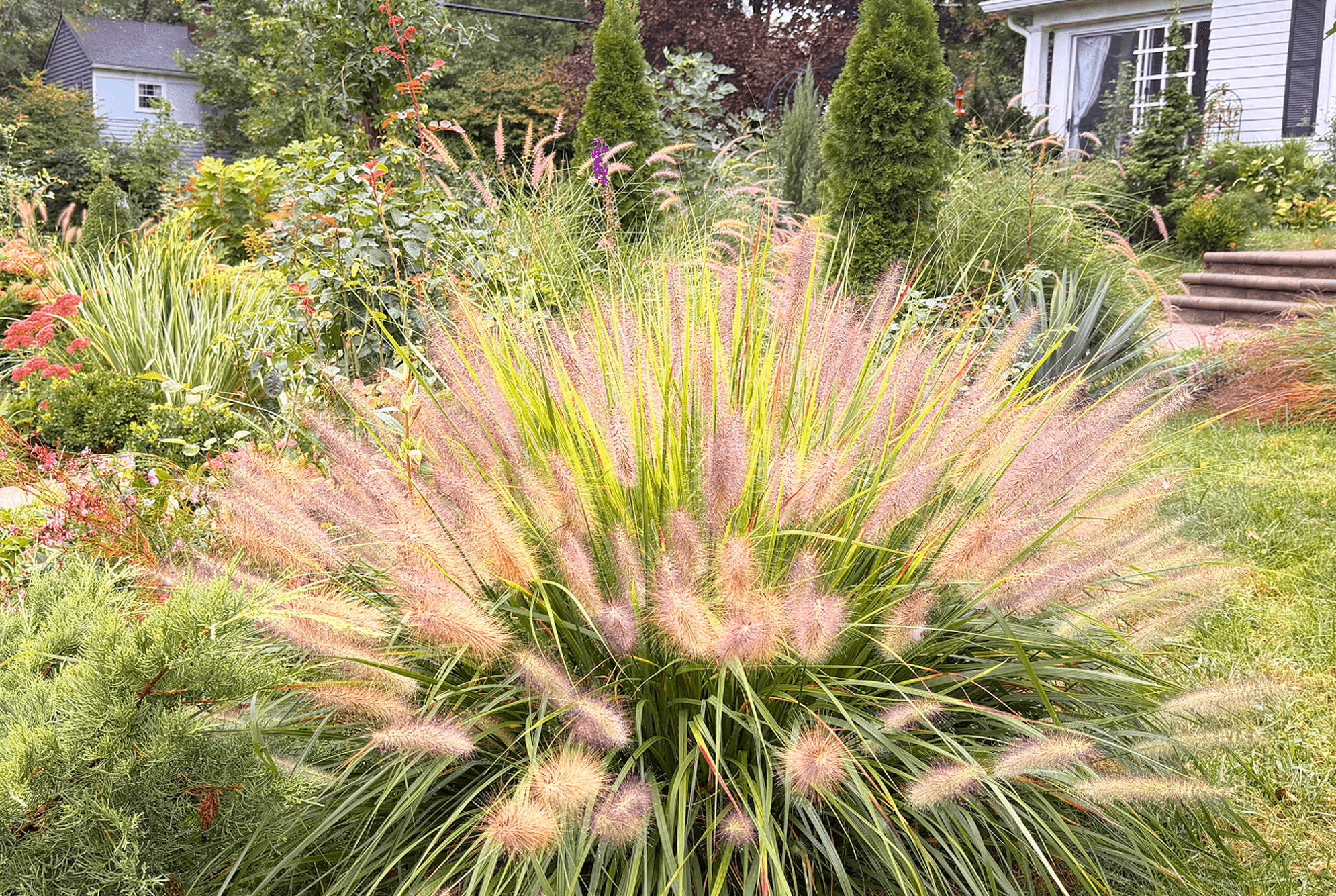
At number two is the exquisite 'Red Head' Fountain Grass. In terms of plant size and form, 'Red Head' is very similar to 'Hameln'—it stays nicely rounded, compact, and manageable within a flower bed. But what elevates it to #2 are its stunning bloom heads. The plumes are exceptionally thick, super fuzzy, and start off in late summer with a striking smoky pinkish-red hue.
When planted near mid-sized flowering shrubs like panicle hydrangeas, the soft bottle-brush texture makes the whole bed look like a professionally arranged florist bouquet. Whenever I capture garden footage or photos, I always make sure a blade of 'Red Head' is peeking into the frame. Best of all, it starts blooming early—by August, your garden is already decorated with these velvety plumes!

Look at this gorgeous grass during golden hour! It's amazing!
Growing Needs for 'Red Head' Fountain Grass:
Expect 'Red Head' to reach a mature height of 3 to 4 feet tall with a spread of 3 to 4 feet wide. Plant it in full sun to encourage early blooming and deep burgundy-pink coloration on the seed heads. Hardy in USDA Zones 5 through 9, it performs best in moist but well-draining soils rich in organic matter. Regular watering during summer dry spells will keep the blooms full and plush.
1. 'Karley Rose' Fountain Grass
(Pennisetum orientale 'Karley Rose')
Get 'Karley Rose' Fountain Grass 10% off here.
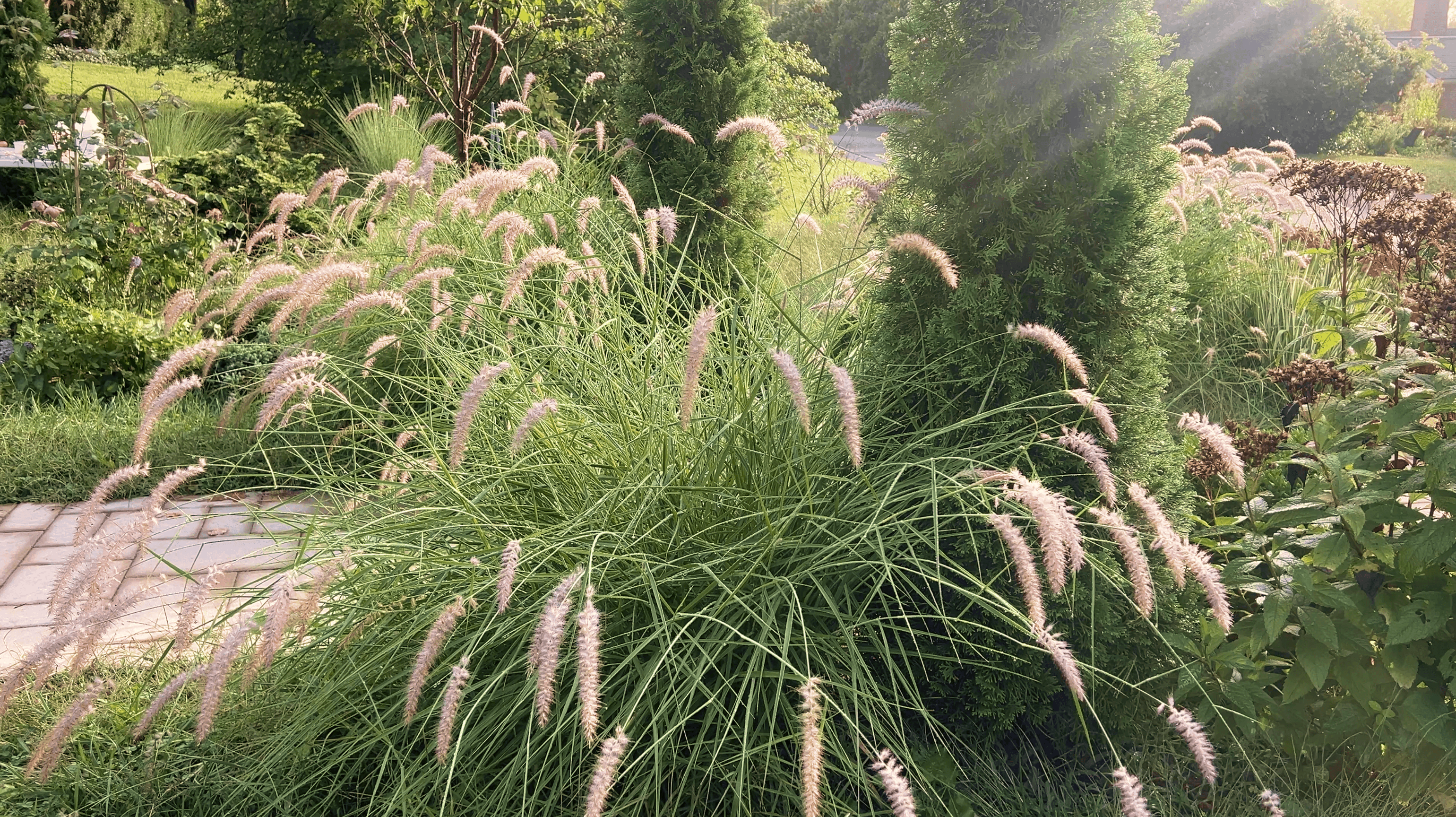
Finally, we have reached my absolute favorite, top-performing ornamental grass: 'Karley Rose' Fountain Grass! While it might look like a standard fountain grass at first glance, its garden performance is nothing short of extraordinary.
There are several reasons why 'Karley Rose' takes the crown in my cottage garden:
Ultra-Early Bloom Time: Unlike many late-season grasses, 'Karley Rose' begins putting on its show early in the summer. By July/August, it is already bursting with rich, rose-pink plumes.
Impressive Height: While the foliage forms a substantial clump approximately 2–3 feet wide, the elegant flower stems rise above it, reaching up to 5 feet tall!
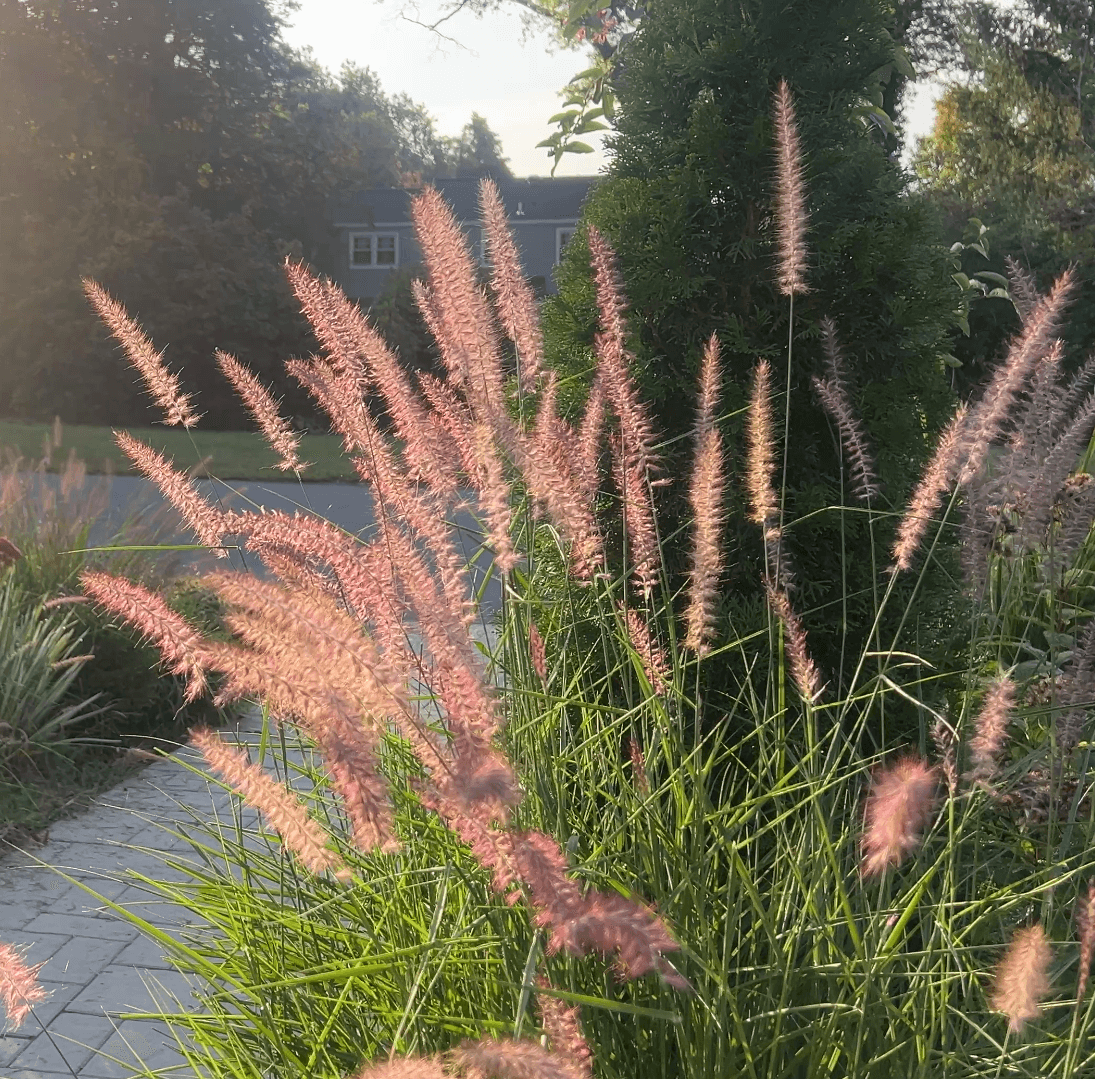
Because the blooms reach up to five feet high, 'Karley Rose' belongs near the mid-to-back end of your flower bed. When I wake up in the morning, grab my cup of coffee, and look out over my garden, the soft pink plumes of 'Karley Rose' are tall enough to tower over the surrounding plants, floating above the entire landscape. It catches the morning light in a way that makes the whole yard feel magical!
Growing Needs for 'Karley Rose' Fountain Grass:
'Karley Rose' grows to a foliage height of 2 to 3 feet, with flower spikes extending up to 3 to 5 feet high, and a manageable columnar spread of 2 to 3 feet. It performs best in full sun and is hardy across USDA Zones 5 through 9. It enjoys well-draining soil with average moisture levels. 'Karley Rose' is notably more tolerant of varying soil conditions than many other oriental fountain grasses and responds very well to an annual spring clean-up.
How to Grow Ornamental Grasses
Ornamental grasses are as close to plant-it-and-forget-it as gardening gets.
Sun: Most varieties need full sun — at least 6 hours a day
Soil: Average, well-drained soil. Avoid rich soil — it causes floppy growth
Water: Drought tolerant once established. No supplemental watering needed after year one
Cutting back: Cut to 4–6 inches in late February before new growth emerges. Use a rubber band to bundle the grass first — makes cleanup much easier
Dividing: Every 3–4 years, dig and divide when the center dies out. Replant the healthy outer sections
Clumping vs. running: Always choose clumping varieties like Karl Foerster or Shenandoah for a well-behaved garden
If you are plant shopping in late summer or autumn, remember: don't be turned off by dry, stressed, or dormant-looking nursery pots. Grasses are incredibly resilient. Plant them in appropriate light, water them in well, and leave them alone over winter. Come next spring, prune the old dead foliage back down to a few inches above the soil line, and they will flush out with vibrant, fresh growth that will elevate your cottage garden for years to come.

Frequently Asked Questions
When is the best time of year to cut back ornamental grasses?
It is best to wait until late winter or early spring (just before new green growth begins to emerge) to cut back warm-season ornamental grasses. Leaving the dry foliage and plume stems intact through late autumn and winter not only provides beautiful winter interest in snowy landscapes, but the dead foliage also protects the plant's crown from harsh freezing temperatures and offers shelter for overwintering beneficial insects.
Why are my ornamental grasses flopping over in the middle?
Ornamental grasses usually flop over for two main reasons: lack of sufficient sunlight or overly rich, over-fertilized soil. Most warm-season grasses (like Muhly grass and Switchgrass) require full sun (at least 6 hours daily) to build strong, rigid stems. Additionally, giving them too much nitrogen fertilizer or planting them in heavily amended soil causes quick, weak, leggy growth that collapses under its own weight.
How far apart should I plant ornamental grasses in a cottage garden border?
Spacing depends on the mature spread of the specific variety. For compact fountain grasses like 'Hameln' or 'Red Head' (which spread 3 to 4 feet wide), space them about 3 feet apart on center if you want a continuous, touching mass, or 4 to 5 feet apart if you want individual architectural specimens. For upright, narrow grasses like 'Cheyenne Sky' or 'Karley Rose', spacing them 2 to 3 feet apart works beautifully in cottage borders.
Do ornamental grasses need to be divided?
Over time (usually every 3 to 5 years), the center of an ornamental grass clump may begin to die out or become hollow, resulting in fewer blooms. When this happens, spring is the perfect time to dig up the entire root ball just as new shoots appear, slice the healthy outer ring into smaller sections using a sharp spade or saw, and replant the vigor-rich divisions around your garden.
Final Thoughts
Adding ornamental grasses to your garden is one of the easiest, most rewarding ways to add texture, movement, and light to your landscape design. Whether you choose the structural elegance of 'Karley Rose', the cozy charm of 'Red Head', or the subtle beauty of 'Cheyenne Sky', these low-maintenance plants will reward you season after season.
So next time you're browsing the garden center, don't walk past those unassuming pots of grass! Pick one up, get it in the soil, and enjoy the breathtaking sight of morning sunlight dancing through swaying plumes. Happy gardening!
Key Takeaways
All six picks stay in the 2–5 ft range so they add texture without taking over the rest of the border.
'Karley Rose' Fountain Grass is my #1 pick. It blooms months earlier than the others and its 5 ft plumes float above everything else in the bed.
Don't skip sad-looking dormant nursery pots in fall — grasses bounce back fast once planted.
Pink Muhly Grass gives the best fall color but tends to flop; 'White Cloud' Muhly is the sturdier, upright alternative with the same misty look.
Once established, none of these need heavy feeding or winter protection — just one cutback to a few inches above soil in late winter/early spring.
🌾 6 grasses, 2–5 ft tall | ☀️ Full sun | 🌱 Low maintenance | ✂️ Cut back late winter/early spring
I don't know about you, but for the longest time, I felt completely confused by ornamental grasses. When you walk through a plant nursery, it is almost impossible to imagine what they will look like in your garden beds a year, two, or three down the road.
However, after adding them into my own cottage garden, I can tell you without hesitation: do not skip these wonderful plants.
They are absolute must-haves!
In a cottage garden, ornamental grasses bring texture, structure, and dynamic motion. And they make your garden lush, even when your flowers are done blooming.
Best Low Maintenance Ornamental Grasses
To help you navigate the overwhelming options at the garden center, I am sharing six of my favorite ornamental grasses. For me they are must-have plants for a low maintenance garden design. I’ve ranked them starting from my least favorite up to my absolute #1 top performer, showing you exactly how they behave in a real cottage garden landscape!
The varieties I share here fall right into the sweet spot of 2-5 feet tall, because they never overpower the surrounding plants.
You can also watch my video here:
Shop My Favorite
Ornamental Grasses
6. 'Cheyenne Sky' Switch Grass
(Panicum virgatum 'Cheyenne Sky')
Get 'Cheyenne Sky' Switch Grass 10% off here.
At number six on my list is 'Cheyenne Sky' Switch Grass. I have a soft spot for this plant because of its incredible resilience. Last fall, I bought a pitiful, completely dry-looking clump on clearance. By this fall, it had recovered so beautifully! It serves as a fantastic reminder to all gardeners: don't be afraid of those sad, end-of-season clearance grasses. Given a little time and soil, they can look spectacular the following year.
What I love about 'Cheyenne Sky' is its multidimensional color palette.
The foliage has soft, bluish-green tones early in the season that deepen into rich shades of deep purple and rosy pink as the summer turns to autumn. It is a subtle, stunning plant. The only reason it sits at number six on my personal ranking is that it is the least striking grass in my beds right now. You really have to walk up to fully appreciate its colors. It functions wonderfully as a quiet bed filler, weaving together brighter flowers, but it isn't going to be the dramatic showstopper of your garden border.
Growing Needs for 'Cheyenne Sky' Switch Grass:
This tough native cultivar typically reaches a mature height of 2 to 3 feet tall (up to 3 feet when in bloom) with a narrow spread of 1.5 to 2 feet. It thrives best in full sun (at least 6 hours of direct light daily) to maintain its strong, upright habit and vivid purple foliage. Hardy in USDA Zones 4 through 9, 'Cheyenne Sky' is exceptionally adaptable to a wide range of soil types, including heavy clay and dry sandy soils. It requires low to medium moisture and becomes quite drought-tolerant once established.
5. Pink Muhly Grass
(Muhlenbergia capillaris)
Get Pink Muhly Grass 10% off here.
Oh, Pink Muhly Grass! This plant could easily take the number one spot in my heart if it weren't for a few frustrating flaws. When Pink Muhly Grass is in its full autumn glory, it transforms the garden into a romantic, soft, cotton-candy pink cloud. It adds a magical, dreamy haze over the garden beds that takes your breath away.
So why is it down at number five? Simply put, it has a tendency to flop. I have been waiting patiently for my Pink Muhly Grass to look picture-perfect for about four years now, but it has never quite filled out or stood as sturdy as some of my other ornamental grasses. Part of this might be my own fault—I planted it in rich soil. I am currently looking into transplanting it to a new location with leaner soil to see if that tightens up its form. Additionally, it is a late bloomer. The pink plumes usually don't open until October, whereas many of my fountain grasses are already putting on a grand show by mid-summer.
Growing Needs for Pink Muhly Grass:
Pink Muhly Grass reaches a mature height of 2 to 3 feet with a matching spread of 2 to 3 feet. It performs best in full sun and requires very well-draining soil. Hardy in USDA Zones 6 through 10, this grass naturally thrives in poor, lean, or sandy soils; overly rich soil or excess water can actually cause the weak stems to flop over. It is extremely drought-tolerant once established and prefers deep, infrequent waterings.
4. 'White Cloud' Muhly Grass
(Muhlenbergia capillaris 'White Cloud')
If you love the airy, ethereal look of Pink Muhly Grass but want to avoid the flopping issues, 'White Cloud' Muhly Grass is an outstanding alternative. Occupying the fourth spot on my list, this variety has elegant, fine-textured ivory-white haze that looks like delicate mist hovering over your garden beds.
'White Cloud' grows slightly taller and significantly more upright than its pink sibling. It was specifically selected for its architectural strength, meaning you won't spend the season watching your beautiful foliage collapse onto surrounding perennials. Like Pink Muhly, it begins its bloom cycle in October. The fluffy white seed heads start developing right in the center of the plant foliage first, gradually expanding outward until the entire top of the plant is smothered in a soft white veil.
Growing Needs for 'White Cloud' Muhly Grass:
This cultivar achieves a mature height of 3 to 4 feet tall and a spread of 2 to 3 feet wide. It requires a location in full sun to keep its flower stems rigid and upright. Hardy in USDA Zones 6 through 10, 'White Cloud' tolerates heat, humidity, and drought with ease. Plant it in well-draining soil of average to low fertility, and avoid overwatering or heavy fertilizing to preserve its refined upright form.
Real plants. Real garden.
Honest perspective.
I share what works in my garden, including the mistakes!
3. 'Hameln' Dwarf Fountain Grass
(Pennisetum alopecuroides 'Hameln')
Get 'Hameln' Dwarf Fountain Grass 10% off here.
Coming in at number three is a absolute classic: 'Hameln' Dwarf Fountain Grass. This is probably the most standard fountain grass you will find at almost any garden center or nursery, and for good reason! It is an incredibly reliable, low-fuss workhorse in the cottage border.
I love 'Hameln' because of its neat, rounded, mound-forming habit. When you first plant it, it stays around 3 feet tall and 3 feet wide. However, as the years go on, the base slowly expands. The plant in my garden has been in my garden for three years now; it started out small, but today it stretches out to 4+ feet wide! Its rich green foliage arches gracefully outward, topped with creamy, beige-colored "foxtail" plumes that dance in the wind. It's also beautiful in early spring with its lime green blades.
Growing Needs for 'Hameln' Dwarf Fountain Grass:
'Hameln' typically matures to 2 to 3 feet tall and spreads 3 to 4 feet wide over time. It thrives in full sun to light shade, though full sun produces the most abundant blooms. It is hardy in USDA Zones 5 through 9. This grass prefers fertile, medium-moisture, well-draining soils, though it can tolerate periodic dry spells once its roots are settled. Yearly spring cut-backs keep the foliage looking crisp and vigorous.
2. 'Red Head' Fountain Grass
(Pennisetum alopecuroides 'Red Head')
Get 'Red Head' Fountain Grass 10% off here.
At number two is the exquisite 'Red Head' Fountain Grass. In terms of plant size and form, 'Red Head' is very similar to 'Hameln'—it stays nicely rounded, compact, and manageable within a flower bed. But what elevates it to #2 are its stunning bloom heads. The plumes are exceptionally thick, super fuzzy, and start off in late summer with a striking smoky pinkish-red hue.
When planted near mid-sized flowering shrubs like panicle hydrangeas, the soft bottle-brush texture makes the whole bed look like a professionally arranged florist bouquet. Whenever I capture garden footage or photos, I always make sure a blade of 'Red Head' is peeking into the frame. Best of all, it starts blooming early—by August, your garden is already decorated with these velvety plumes!
Look at this gorgeous grass during golden hour! It's amazing!
Growing Needs for 'Red Head' Fountain Grass:
Expect 'Red Head' to reach a mature height of 3 to 4 feet tall with a spread of 3 to 4 feet wide. Plant it in full sun to encourage early blooming and deep burgundy-pink coloration on the seed heads. Hardy in USDA Zones 5 through 9, it performs best in moist but well-draining soils rich in organic matter. Regular watering during summer dry spells will keep the blooms full and plush.
1. 'Karley Rose' Fountain Grass
(Pennisetum orientale 'Karley Rose')
Get 'Karley Rose' Fountain Grass 10% off here.
Finally, we have reached my absolute favorite, top-performing ornamental grass: 'Karley Rose' Fountain Grass! While it might look like a standard fountain grass at first glance, its garden performance is nothing short of extraordinary.
There are several reasons why 'Karley Rose' takes the crown in my cottage garden:
Ultra-Early Bloom Time: Unlike many late-season grasses, 'Karley Rose' begins putting on its show early in the summer. By July/August, it is already bursting with rich, rose-pink plumes.
Impressive Height: While the foliage forms a substantial clump approximately 2–3 feet wide, the elegant flower stems rise above it, reaching up to 5 feet tall!
Because the blooms reach up to five feet high, 'Karley Rose' belongs near the mid-to-back end of your flower bed. When I wake up in the morning, grab my cup of coffee, and look out over my garden, the soft pink plumes of 'Karley Rose' are tall enough to tower over the surrounding plants, floating above the entire landscape. It catches the morning light in a way that makes the whole yard feel magical!
Growing Needs for 'Karley Rose' Fountain Grass:
'Karley Rose' grows to a foliage height of 2 to 3 feet, with flower spikes extending up to 3 to 5 feet high, and a manageable columnar spread of 2 to 3 feet. It performs best in full sun and is hardy across USDA Zones 5 through 9. It enjoys well-draining soil with average moisture levels. 'Karley Rose' is notably more tolerant of varying soil conditions than many other oriental fountain grasses and responds very well to an annual spring clean-up.
How to Grow Ornamental Grasses
Ornamental grasses are as close to plant-it-and-forget-it as gardening gets.
Sun: Most varieties need full sun — at least 6 hours a day
Soil: Average, well-drained soil. Avoid rich soil — it causes floppy growth
Water: Drought tolerant once established. No supplemental watering needed after year one
Cutting back: Cut to 4–6 inches in late February before new growth emerges. Use a rubber band to bundle the grass first — makes cleanup much easier
Dividing: Every 3–4 years, dig and divide when the center dies out. Replant the healthy outer sections
Clumping vs. running: Always choose clumping varieties like Karl Foerster or Shenandoah for a well-behaved garden
If you are plant shopping in late summer or autumn, remember: don't be turned off by dry, stressed, or dormant-looking nursery pots. Grasses are incredibly resilient. Plant them in appropriate light, water them in well, and leave them alone over winter. Come next spring, prune the old dead foliage back down to a few inches above the soil line, and they will flush out with vibrant, fresh growth that will elevate your cottage garden for years to come.
Frequently Asked Questions
When is the best time of year to cut back ornamental grasses?
It is best to wait until late winter or early spring (just before new green growth begins to emerge) to cut back warm-season ornamental grasses. Leaving the dry foliage and plume stems intact through late autumn and winter not only provides beautiful winter interest in snowy landscapes, but the dead foliage also protects the plant's crown from harsh freezing temperatures and offers shelter for overwintering beneficial insects.
Why are my ornamental grasses flopping over in the middle?
Ornamental grasses usually flop over for two main reasons: lack of sufficient sunlight or overly rich, over-fertilized soil. Most warm-season grasses (like Muhly grass and Switchgrass) require full sun (at least 6 hours daily) to build strong, rigid stems. Additionally, giving them too much nitrogen fertilizer or planting them in heavily amended soil causes quick, weak, leggy growth that collapses under its own weight.
How far apart should I plant ornamental grasses in a cottage garden border?
Spacing depends on the mature spread of the specific variety. For compact fountain grasses like 'Hameln' or 'Red Head' (which spread 3 to 4 feet wide), space them about 3 feet apart on center if you want a continuous, touching mass, or 4 to 5 feet apart if you want individual architectural specimens. For upright, narrow grasses like 'Cheyenne Sky' or 'Karley Rose', spacing them 2 to 3 feet apart works beautifully in cottage borders.
Do ornamental grasses need to be divided?
Over time (usually every 3 to 5 years), the center of an ornamental grass clump may begin to die out or become hollow, resulting in fewer blooms. When this happens, spring is the perfect time to dig up the entire root ball just as new shoots appear, slice the healthy outer ring into smaller sections using a sharp spade or saw, and replant the vigor-rich divisions around your garden.
Final Thoughts
Adding ornamental grasses to your garden is one of the easiest, most rewarding ways to add texture, movement, and light to your landscape design. Whether you choose the structural elegance of 'Karley Rose', the cozy charm of 'Red Head', or the subtle beauty of 'Cheyenne Sky', these low-maintenance plants will reward you season after season.
So next time you're browsing the garden center, don't walk past those unassuming pots of grass! Pick one up, get it in the soil, and enjoy the breathtaking sight of morning sunlight dancing through swaying plumes. Happy gardening!
Key Takeaways
All six picks stay in the 2–5 ft range so they add texture without taking over the rest of the border.
'Karley Rose' Fountain Grass is my #1 pick. It blooms months earlier than the others and its 5 ft plumes float above everything else in the bed.
Don't skip sad-looking dormant nursery pots in fall — grasses bounce back fast once planted.
Pink Muhly Grass gives the best fall color but tends to flop; 'White Cloud' Muhly is the sturdier, upright alternative with the same misty look.
Once established, none of these need heavy feeding or winter protection — just one cutback to a few inches above soil in late winter/early spring.

Written by Jolanta Reynolds
You Might Like
You Might Like


You Might Like

Subscribe to my newsletter
Get new garden posts, seasonal tips, and what's blooming in my New Jersey cottage garden — straight to your inbox.
By subscribing, you agree to the Privacy Policy
Subscribe
to my
newsletter
Get new garden posts, seasonal tips, and what's blooming in my New Jersey cottage garden — straight to your inbox.
By subscribing, you agree to the Privacy Policy