Lawn to Garden
How to Create a Cottage Garden: My 5-Layer Rule for Year-Round Structure
How to Create a Cottage Garden: My 5-Layer Rule for Year-Round Structure
6
min read


Written by Jolanta Reynolds
Like most people, I started with a dream of a lush romantic garden and decided to try my hand in English cottage garden design. We had just bought a 100-year-old house with a very empty front lawn, so I started with two flower beds: one by the house foundation and one near my lamp post. I removed the sod (you can see the methods I have since perfected in my guide on How to Remove Grass for Garden Beds) planted classic cottage staples like foxgloves and delphiniums. I also sowed a variety of annuals and perennials from seed, like echinacea (purple coneflower), cosmos and zinnias.
That first year came a realization: growing plants is surprisingly easy.
Designing a cottage garden that looks good all season is another matter!
By midsummer, my favorite spring flowers had disappeared, the summer perennials were an overgrown, floppy mess, and in January there was nothing to look at but bare mulch.
I didn't give up. I just started paying attention. I visited botanical gardens across the U.S. and Europe, I tested plants in my own front yard in New Jersey (Zone 7a), and slowly I saw a pattern. The cottage gardens that looked good all year were not the ones with the most flowers. They were the ones with a structure under the flowers.
That's how I came up with what I call the Colonial Cottage Garden™ 5-layer rule. It's how I turned my plain front lawn into ten flower beds while working full-time and raising my family. And it's the reason my garden still looks lush and organized in every season.
The 5 Layers at a Glance
Green Bones: Architectural evergreens for height, winter interest, and year-round backbone.
Pretty Bones: Low-maintenance flowering shrubs for easy, generous cottage abundance.
Movement: Ornamental grasses to soften hard edges and fill bare space.
Personality: Hardy perennials and self-sowing annuals that showcase your personal color palette.
Romance: Climbing roses, trellises, and obelisks for vertical drama and the classic cottage feel.
The order matters. Each layer holds up the next one. If you start with layer four, like I did, you get my July mess.
1. Green Bones: Evergreens

English cottage gardens have something we don't: old stone walls, brick paths and hedges that are a hundred years old. That's what makes all those flowers look charming instead of underwhelming. Most American front yards have a lawn and a foundation.
So evergreens take that job. I call them the green bones. They give every bed a backbone, they give your yard height, and they are the only thing still standing in January.
My take: This is the layer everyone wants to skip because it isn't exciting. Don't skip it. When I added evergreens, my beds finally looked like a garden and not like a plant collection. I place them first and I repeat many in different beds. Repeating is what makes the whole yard feel connected.
2. Pretty Bones: Flowering Shrubs

Next come the flowering shrubs. These are the pretty bones. They give you big, generous flowers that read as cottage abundance, but you plant them once and mostly leave them alone.
You don't need anything rare. The ones I love are easy shrubs you can find at any local nursery. The trick is where you put them, not what they are.
My take: Flowering shrubs are the best deal in the garden. One shrub fills the space of ten perennials, and it comes back bigger every year without dividing, staking or fussing.
3. Movement: Grasses

Grasses are the layer people forget, and they are the one I would never give up now. I set them toward the edges of each bed. They fill space fast, they hide the bare spots, and when the breeze moves through them, the whole garden softens.
My take: Grasses are what make a structured garden still feel relaxed and romantic. Without them, evergreens and shrubs can look a little stiff. With them, it starts to feel like a cottage garden.
They also carry the garden through fall and winter, when most flowers are long done. I leave them standing until spring cleanup.
4. Personality: Perennials & Annuals

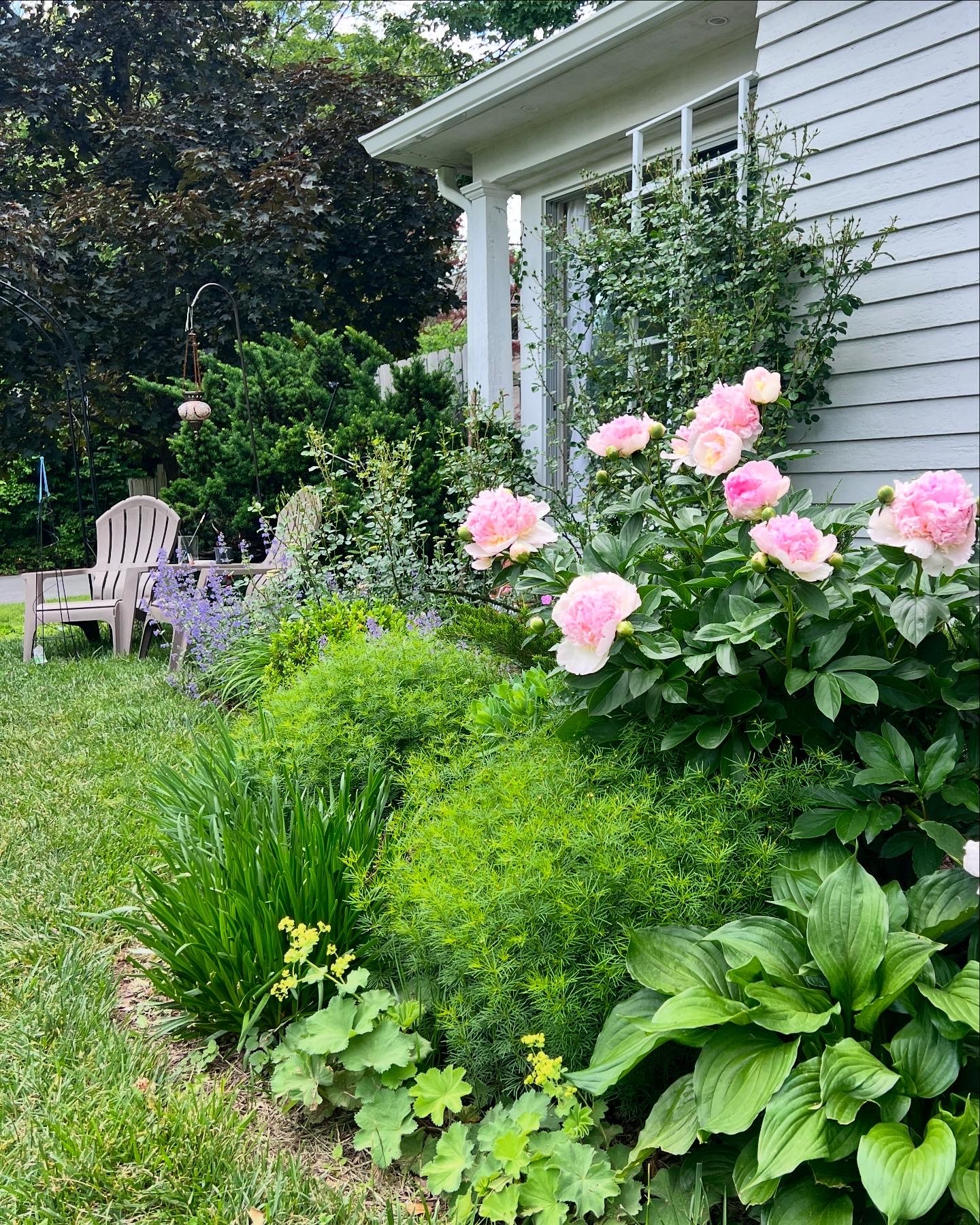
Now the fun part. This is where your personal style takes over. Once the bones and the grasses are in, you fill in between them with perennials and annuals. Can you spot evergreens that make this flower bed look so rich?
That's right! Against their rich green, my flowers pop!
Because the structure is already there, you can't really get this layer wrong. Love soft pastels? Go for it. Want bright and wild? Also fine. The first three layers keep it from turning into chaotic confetti mess.
My take: This is where I used to start, and that was my big mistake. Perennials alone flop, go dormant, and leave beds bare. Planted between the bones, they look full and intentional. I also sow a few annuals from seed every year to fill the gaps for almost nothing.
5. Romance: Roses & Garden Structure

The final touch, if you are aiming for a romantic cottage garden. Rustic obelisks, trellises, an arch, and of course roses. This layer is pure romance. It's what makes people stop on the sidewalk. A single obelisk with a climbing rose does more than ten new perennials.
My take: This last layer is the cherry on top. Your garden will already look amazing with the first four layers. This one gives it a true cottage garden vibe. You can add it around the same time you plant your flowering shrubs. So why do I call it the fifth layer? I have to be honest: roses are the real divas of the garden. They require more work than most of my other plants. So if you want a low-effort, low-maintenance garden, don't give in to an obsession of adding too many like I did, or you will spend your spring, summer and fall spraying, snipping and pegging.
Why the Order Matters
Think of it like getting dressed. The evergreens and shrubs are the good coat. The grasses are the scarf. The perennials are your outfit, and the roses are the jewelry. Jewelry alone is not an outfit.
When I plant a new bed now, I always go in the same order: green bones, pretty bones, movement, personality, romance. Then I repeat it in the next bed. That's it. That's the whole approach, and it's how my front lawn slowly turned into a garden, one bed at a time.
See the result: Want to see what five years of this looks like? See my front-yard lawn-to-garden transformation.
Key Takeaways
Structure first: evergreens and flowering shrubs keep a cottage garden from looking messy by July.
Grasses soften: they fill space fast and make a structured bed feel relaxed.
Perennials are personal: once the bones are in, you can plant your style without worrying.
Romance last: roses and obelisks are the finishing touch, not the starting point.
Repeat it: use the same five layers in every bed so the whole yard feels connected.
Frequently Asked Questions
How do I keep a cottage garden from looking messy?
Give it structure before you add flowers. Evergreens and flowering shrubs act as the "bones" of the bed, so perennials and annuals have something to fill around instead of flopping into each other.
What should I plant first in a new flower bed?
Start with evergreens, then flowering shrubs, then grasses. Perennials, annuals and roses come after. Planting in this order means the bed looks good all year, not just in June.
Does a cottage garden look good in winter?
It can. With evergreens and grasses in every bed, you still have shape, height and movement in January, even when the flowers are gone.
Can I use this approach in a small yard?
Yes. The five layers work in one small bed as well as a whole front yard. Just use fewer plants of each layer and keep the same order.
Happy gardening. 🌸
Like most people, I started with a dream of an English cottage garden. We had just bought a 100-year-old house with a very empty front lawn, and I decided to start with two flower beds: one by the house foundation and one near my lamp post. I removed the sod (you can see the methods I have since perfected in my post How to Remove Grass for Garden Beds) and started by planting my favorite cottage garden staples like foxgloves and delphiniums. I also tried my luck sowing a variety of annuals and perennials from seed, like echinacea, cosmos and zinnias.
That first year came a realization: growing plants is surprisingly easy. Making them look good all season is another matter!
By midsummer, my favorite spring flowers had disappeared, my summer bloomers were unruly, overgrown and too dry, and in January there was nothing to look at but mulch.
I didn't give up. I just started paying attention. I visited botanical gardens across the U.S. and Europe, I tested plants in my own front yard in New Jersey, and slowly I saw a pattern. The gardens that looked good all year were not the ones with the most flowers. They were the ones with a structure under the flowers.
That's how I came up with what I call the Colonial Cottage Garden™ approach: five layers, planted in order. It's how I turned my plain front lawn into ten flower beds while working full-time and raising my family. And it's the reason my garden still looks lush and organized in every season.
The 5 Layers at a Glance
Green Bones: evergreens for structure and height
Pretty Bones: flowering shrubs for easy abundance
Movement: grasses to soften and fill
Personality: perennials and annuals, your style
Romance: roses and garden structure, the final touch
The order matters. Each layer holds up the next one. If you start with layer four, like I did, you get my July mess.
1. Green Bones: Evergreens
English cottage gardens have something we don't: old stone walls, brick paths and hedges that are a hundred years old. That's what makes all those flowers look charming instead of chaotic. Most American front yards have a lawn and a foundation.
So evergreens take that job. I call them the green bones. They give every bed a backbone, they give your yard height, and they are the only thing still standing in January.
My take: This is the layer everyone wants to skip because it isn't exciting. Don't skip it. When I added evergreens, my beds finally looked like a garden and not like a plant collection.
How I use them: I place them first, usually toward the back or at the corners of a bed, and I repeat the same ones in different beds. Repeating is what makes the whole yard feel connected.
2. Pretty Bones: Flowering Shrubs
Next come the flowering shrubs. These are the pretty bones. They give you big, generous flowers that read as cottage abundance, but you plant them once and mostly leave them alone.
You don't need anything rare. The ones I love are easy shrubs you can find at any local nursery. The trick is where you put them, not what they are.
My take: Shrubs are the best deal in the garden. One shrub fills the space of ten perennials, and it comes back bigger every year without dividing, staking or fussing.
3. Movement: Grasses
Grasses are the layer people forget, and they are the one I would never give up now. I set them toward the edges of each bed. They fill space fast, they hide the bare spots, and when the breeze moves through them, the whole garden softens.
My take: Grasses are what make a structured garden still feel relaxed. Without them, evergreens and shrubs can look a little stiff. With them, it starts to feel like a cottage garden.
They also carry the garden through fall and winter, when most flowers are long done. I leave them standing until spring cleanup.
4. Personality: Perennials & Annuals
Now the fun part. This is where your personal style takes over. Once the bones and the grasses are in, you fill in between them with perennials and annuals.
Because the structure is already there, you can't really get this layer wrong. Love soft pastels? Go for it. Want bright and wild? Also fine. The first three layers keep it from turning messy.
My take: This is where I used to start, and that was my big mistake. Perennials alone flop, go dormant, and leave holes. Planted between the bones, they look full and intentional. I also sow a few annuals from seed every year to fill the gaps for almost nothing.
5. Romance: Roses & Garden Structure
The final touch, if you are aiming for a romantic cottage garden. Rustic obelisks, trellises, an arch, and of course roses. This layer is pure romance. It's what makes people stop on the sidewalk. A single obelisk with a climbing rose does more than ten new perennials.
My take: This last layer is the cherry on top. Your garden will already look amazing with the first four layers. This one gives it a true cottage garden vibe. You can add it around the same time you plant your flowering shrubs. So why do I call it the fifth layer? I have to be honest: roses are the real divas of the garden. They require more work than most of my other plants. So if you want a low-effort, low-maintenance garden, don't give in to an obsession of adding too many like I did, or you will spend your spring, summer and fall spraying, snipping and pegging.
Why the Order Matters
Think of it like getting dressed. The evergreens and shrubs are the good coat. The grasses are the scarf. The perennials are your outfit, and the roses are the jewelry. Jewelry alone is not an outfit.
When I plant a new bed now, I always go in the same order: green bones, pretty bones, movement, personality, romance. Then I repeat it in the next bed. That's it. That's the whole approach, and it's how my front lawn slowly turned into a garden, one bed at a time.
See the result: Want to see what five years of this looks like? See my front-yard lawn-to-garden transformation.
Key Takeaways
Structure first: evergreens and flowering shrubs keep a cottage garden from looking messy by July.
Grasses soften: they fill space fast and make a structured bed feel relaxed.
Perennials are personal: once the bones are in, you can plant your style without worrying.
Romance last: roses and obelisks are the finishing touch, not the starting point.
Repeat it: use the same five layers in every bed so the whole yard feels connected.
Frequently Asked Questions
How do I keep a cottage garden from looking messy?
Give it structure before you add flowers. Evergreens and flowering shrubs act as the "bones" of the bed, so perennials and annuals have something to fill around instead of flopping into each other.
What should I plant first in a new flower bed?
Start with evergreens, then flowering shrubs, then grasses. Perennials, annuals and roses come after. Planting in this order means the bed looks good all year, not just in June.
Does a cottage garden look good in winter?
It can. With evergreens and grasses in every bed, you still have shape, height and movement in January, even when the flowers are gone.
Can I use this approach in a small yard?
Yes. The five layers work in one small bed as well as a whole front yard. Just use fewer plants of each layer and keep the same order.
Happy gardening. 🌸
You Might Like
You Might Like


You Might Like

Subscribe to my newsletter
Get new garden posts, seasonal tips, and what's blooming in my New Jersey cottage garden — straight to your inbox.
By subscribing, you agree to the Privacy Policy
Subscribe
to my
newsletter
Get new garden posts, seasonal tips, and what's blooming in my New Jersey cottage garden — straight to your inbox.
By subscribing, you agree to the Privacy Policy